
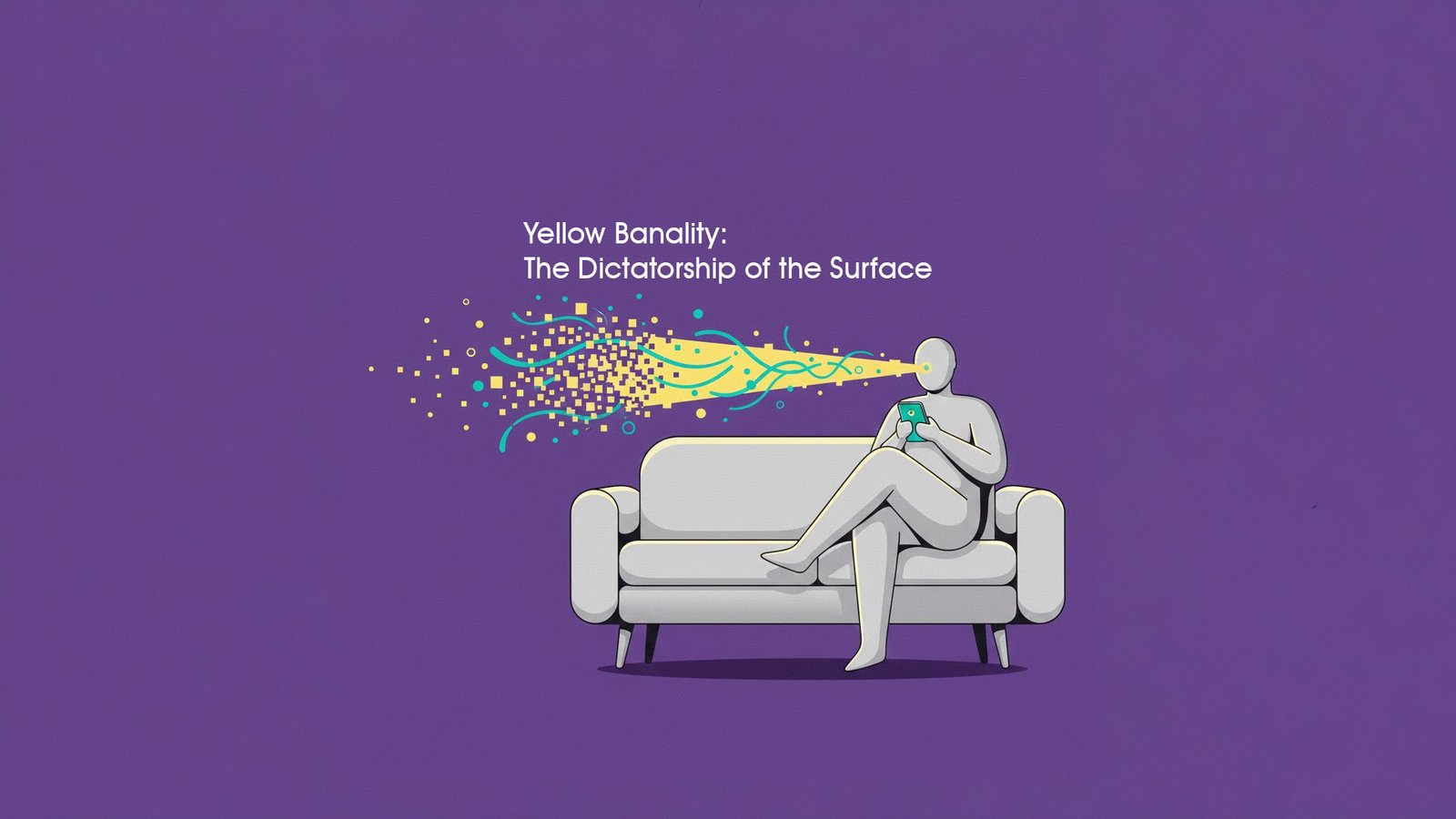
Yellow Banality: The Dictatorship of the Surface
“Yellow Banality” isn’t a matter of taste for me; it’s not a debate between listening to Mozart or pop trash. The issue is a deeper cultural habit: the habit of swallowing without chewing. A place where speed and surface replace time and roots. In this slaughterhouse, content isn’t something to “live” with; it is a piece of meat for the hook of attention. And attention? It is the only currency these days that inflation hasn’t yet crippled.
Scene One: Scrolling, or The Practice of Forgetting
The most honest portrait of modern man isn’t a painting; it is the image of someone bathed in the blue light of a mobile phone, dragging a finger across glass. A mechanical, repetitive, endless motion.
We no longer see the world; we scroll it. Images come and go faster than they can settle on the retina, let alone the soul. “Yellow” is no longer an adjective for newsstand tabloids; it is the “state of the world.” A pattern that has chewed through everything from politics to art, and from design to our bedroom relationships.
For me, banality isn’t the ugliness of form; banality is the deletion of time. It is where “reflection” is slaughtered for the sake of “speed.” We have forgotten that beauty is expensive; and the cost isn’t money, it is time.
Scene Two: The Attention Economy and the Death of the Pause
In today’s bazaar, the commodity isn’t “content”; the commodity is “your eyes.” Content is merely bait placed on a hook to hunt the fish (the audience) and sell it to the advertiser. When attention becomes a sellable good, content is forced to “scream.” It must be fast, simple, and like fast food, satiating in the moment, leaving you hungry an hour later.
Static Acceleration: Platforms are designed so we run like lab rats on a wheel. We are constantly moving, but getting nowhere. Anything requiring a pause, silence, or a re-read is considered “excess waste” by the algorithm and discarded.
The Victory of Form over Meaning: It doesn’t matter what you say, it matters how “chic” you look. Words have become hollow; only a shell of “style” and “color” remains. A neon aesthetic that fills the eye for seconds and empties the brain.
A Defense of Speed: Tool or Master?
Let’s be clear: I am not an enemy of speed. Speed in data transmission is the miracle of our age. That I can send my voice across the ocean in a second is the glory of technology. The problem begins when we turn speed from a “tool of transmission” into a “method of thought.”
There is a difference between the speed of access to the Library of Congress and the speed of reading a summary of those books in a tweet. We do not blame the machine; we criticize the surrender of the mind to the rhythm of the machine. The machine must be fast so that the human has more time to be slow (to reflect), not so the human runs like the machine. Yellow banality is the collision of “fast machines” with “hasty humans.”
Scene Three: The Anatomy of Yellow
1. The Butchery of Depth
Yellow banality is wanting to understand the world with a single headline. Narratives promising to change your life in 30 seconds (and likely succeeding in wasting 30 seconds of it). Here, depth is sacrificed to raise the “Engagement” graph. We have become addicted to the feeling of understanding, without the suffering of understanding.
2. Imitation: The Copy-Paste Factory
For me, being yellow means separating form from root. It is the artist or writer who, instead of consulting their own wounds, looks at the Instagram “Explore” page to see what gets likes. Authentic creation is always dangerous; there is always a chance of screwing up. But “imitation” is safe. We are drowning in an ocean of safe copies that differ only in their color filters.
3. The Pornography of Emotion
The darkest corner of the story: turning suffering, bodies, and crises into “content.” Crying in front of the camera not for empathy, but for views. We watch others’ pain, get emotional for a moment (to soothe our conscience), and then scroll to the next video, which is likely dancing or cooking. Suffering becomes décor. This is the exploitation of emotions; a modern vampirism with a white napkin.
Scene Four: Sterile Beauty
The world is full of “hotel beauty.” Graphic designs that are clean, minimal, flawless, but dead. Like a hotel room where everything is in its place, but no one has lived in it. No smell, no memory, no trace of a human being. Beauty without a footprint, without flaws, and without history is not beauty; it is a display window.
Scene Five: The Trojan Horse Strategy
You might ask: “How does one survive in this yellow market without disappearing?” The answer is not in isolation; it is in infiltration. We need a “Tactical Realism.”
The Trojan Horse: If the audience seeks appealing form, give it to them. Use the aesthetics of the day—the light, the rhythm, the polish—but hide the soldiers of “meaning” inside. Smuggle depth in a package of attractive form. Art today is the smuggling of meaning.
Building a Tribe, Not a Stadium: Building a tribe of 1,000 people who understand you is better than a stadium of 100,000 who merely watch you.
The Platform as a Showroom: We can cast hooks on Instagram, but we must invite the fish to the website, the podcast, or the book.
Final Scene: Resistance Against the Fall
Authenticity means your work smells like you. The smell of time, thought, and lived experience.
Whenever I wanted to be authentic, I had to slow down. I was forced to sacrifice “being seen” for “being right.” Perhaps the first step is a pause. A simple question before every click or creation: “Is this thing I’m seeing or making just to be seen, or does it have roots in the soil?”
Perhaps our duty is to build a meaningful silence amidst these purple screams.
